
Ring Size Chart & Guide
How To Measure Ring Size at Home | Expert Tips and Conversion Charts
Find Your Perfect Ring Size
Whether your shopping for an engagement ring, wedding band or if you would just like to add a new ring to your jewellery box, getting the right size is essential for comfort and style.

| UK SIZE | US SIZE | EU SIZE | JAPAN SIZE | DIAMETER (mm) |
|---|---|---|---|---|
| J | 5 | 49 | 9 | 15.6 |
| J½ | 50 | 9 | 15.8 | |
| K | 5½ | 50 | 10 | 16.0 |
| K½ | 51 | 10 | 16.1 | |
| L | 6 | 52 | 11 | 16.4 |
| L½ | 52 | 12 | 16.6 | |
| M | 6½ | 53 | 12 | 16.8 |
| M½ | 53 | 13 | 17.0 | |
| N | 7 | 54 | 14 | 17.2 |
| N½ | 55 | 14 | 17.4 | |
| O | 7½ | 55 | 15 | 17.6 |
| O½ | 56 | 15 | 17.8 | |
| P | 8 | 57 | 16 | 18.0 |
| P½ | 57 | 17 | 18.2 | |
| Q | 8½ | 58 | 17 | 18.4 |
| R | 9 | 59 | 18 | 18.8 |
| S | 9½ | 60 | 20 | 19.2 |
| T | 10 | 62 | 21 | 19.6 |
| U | 10½ | 63 | 22 | 20.0 |
| V | 11 | 64 | 23 | 20.4 |
| W | 12 | 67 | 26 | 21.2 |
| Y | 12½ | 68 | 27 | 21.6 |
| Z | 13 | 68 | 27 | 21.8 |
Quick Size Reference
Most Popular Women's Sizes: L (UK) / 6 (US) to P (UK) / 8 (US)
Most Popular Men's Sizes: R (UK) / 9 (US) to V (UK) / 11 (US)
Average Sizes: Women: N (UK) / 7 (US) | Men: T (UK) / 10 (US)
How to Measure Ring Size at Home
Method 1: String or Paper Strip Method
This is the most popular and accurate method for measuring your ring size at home. You'll need a piece of string or a thin strip of paper, a ruler and a pen.
- Cut a strip of paper about 6 inches long and 1/4 inches wide, or use a piece of string of a similar length.
- Wrap the paper or string around the base of your ring finger, positioning it where the ring would normally sit.
- Ensure the material is snug but not tight - it should slide over your knuckle comfortably.
- Mark with a pen where the paper or string overlaps to complete the circle.
- Lay the material flat and measure the length from the start to your mark using a ruler in millimetres.
- Use our sizing chart below to convert your measurement to the correct ring size.
Method 2: Existing Ring Measurement
If you have a ring that fits well on the intended finger, you can measure its internal diameter to determine your size.
- Choose a ring that fits comfortably on the finger you want to size.
- Place the ring on a flat surface and measure the internal diameter using a ruler.
- Measure from the inside edge to the opposite inside edge, ensuring you measure the widest part.
- Record your measurement in millimetres for the most accurate
conversion. - Use our diameter conversion chart to find your corresponding
UK ring size. - Consider that different ring styles may require slight size adjustments.
Method 3: Professional Ring Sizer (Recommended)
For the most accurate measurement, we recommend using a professional ring sizer. We include one free with every Lily Blanche order, or you can request one from most local jewellers.
Using a Ring Sizer:
- Slide the ring sizer onto your finger, starting with a smaller size.
- Gradually increase the size until you find one that slides over your knuckle with slight resistance.
- The correct size should feel snug but comfortable, allowing for natural finger movement.
- Test the fit by making a fist, the ring should not feel uncomfortably tight.
Why Professional Ring Sizers Are Best
- Account for Knuckle size variations
- Test actual ring thickness.
- Provide Consistent, Standardised measurements.
- Allow for comfort testing with movement.
Expert Ring Sizing Tips
-
Timing Matters
Your finger size constantly changes throughout the day due to temperature, activity and fluid retention. To get the most accurate measurement, size your finger at the end of the day when your fingers are at their largest.
-
Measure Multiple Times
For accuracy, measure your finger size at least three times on different days. If you get varied results, choose the measurement that is in the middle. If your results are consistant this indicates a reliable size.
-
Knuckle Considerations
If you have a knuckle that is much bigger than the base of your finger, measure both areas and choose the size between the two of these measurements. The ring needs to be able to slide over your knuckle but not be so loose that it can easily spin on your finger.
Ring Size FAQs
What if my measurement falls between two sizes?
If you are between two sizes we generally recommend sizing up rather than sizing down. A slightly looser ring is more comfortable and easier to have resized than one that is too tight. The exception is if you have larger knuckles than the base of your finger. In that case, choose a ring that slides over your knuckle but still sits snug at the base.
Does the width of the ring affect my size?
Yes. Wider bands take up more space on your finger and often fit tighter than slim bands that are the same size. If you are ordering a ring that is over 5mm it's worth sizing up half a size.
What is the most common ring size in the UK?
The average UK ring size for a woman is size N (US size 7) and for men it's T (US size 10). Most women's rings fall between L and P (UK), whilst most men's rings fall between R and V (UK).
Why does my ring size change throughout the day?
Your finger size naturally fluctuates throughout the day due to temperature, activity levels and fluid retention. Your fingers are typically smallest in the morning and largest in the evening. For the most accurate ring size result, measure at the end of the day and take an average of your measurements.
Find Your Perfect Ring
-

Men's rings are a great way to add a touch of style...
-
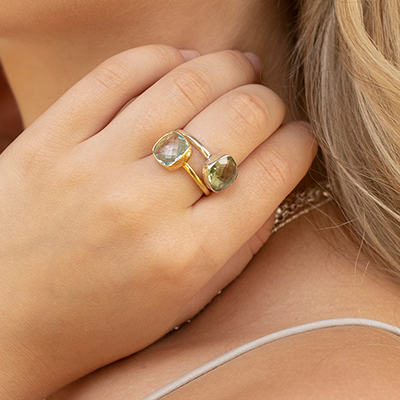
Our beautifully crafted sterling silver rings, featuring dazzling gemstones can be worn...
-

From simple gold bands to spacer rings & stacking rings, we have...


Free Ring Sizer Included
Each Lily Blanche order comes with a complimentary ring sizer as part of our free jewellery care kit. Your ring size can change over time, so it is a handy tool to keep in your jewellery box.